
- Related Articles
- The Luxury of the “Depachika” (Basement Food Halls)
- The “Otoshi” Surprise—Your Table Comes with a Fee (and a Snack)
- The Etiquette of the Glass: Pour for Others, Let Them Pour for You
- Tachinomi—The Art of the Standing Bar
- The Strategy of “Drinks First, Food Later”
- Your Seat at the Table Awaits
- Navigating Tokyo Dining: Food Halls vs. Izakayas
- Tokyo Dining Culture: A Study Guide to Food Halls and Izakayas
Related Articles
This text provides a comprehensive guide to experiencing Tokyo’s vibrant culinary scene by exploring its diverse food halls and traditional izakayas. It highlights food halls as efficient, family-friendly spaces located in department stores and transit hubs where visitors can sample various high-quality dishes at a lower cost. In contrast, the source describes izakayas as essential social hubs rooted in Japanese history, offering a casual environment for enjoying drinks and shared plates.
Readers are provided with practical advice on ordering procedures, cultural etiquette, and common menu items to ensure a smooth dining experience.
Additionally, the text suggests specific neighborhoods for different budgets and offers tips for overcoming language barriers or managing dietary restrictions. Ultimately, the guide serves to help travelers choose the right dining environment to fully appreciate authentic Japanese hospitality.
Tokyo is a city of staggering culinary proportions, a neon-lit labyrinth where 160,000 restaurants compete for your attention. To the uninitiated, the choice is paralyzing: do you follow the smoky scent of charcoal into a Shinjuku alleyway, or step into the hushed, marble-clad elegance of a Ginza department store?
As a cultural insider, I’ve learned that the true heart of Tokyo’s food scene isn’t found on a “Top 10” list, but in the nuanced rituals of its food halls and izakayas. By understanding these spaces, you stop being a spectator and start participating in a centuries-old social fabric.

The Luxury of the “Depachika” (Basement Food Halls)

In the West, a mall food court is often a place of compromise. In Tokyo, it is a destination of reverence. Known as Depachika—a clever portmanteau of depato (department store) and chika (basement)—these subterranean levels in prestigious institutions like Mitsukoshi (三越), Isetan (伊勢丹), and Takashimaya (高島屋) are curated galleries of flavor.
Here, “casual” does not mean “low quality.” In fact, these halls are renowned for their kōhinshitsu (高品質)—an uncompromising high quality that allows you to sample seasonal 5,000-yen fruits or Michelin-adjacent bento boxes for a fraction of a sit-down meal’s price.
“The diversity of cuisines available in these hubs is immense, featuring high-quality Japanese, Western, Chinese, and various ethnic dishes all in one location.”
The “Otoshi” Surprise—Your Table Comes with a Fee (and a Snack)
Upon taking a seat at a traditional izakaya, you will likely be served a small, unsolicited dish before you’ve even opened the menu. This is otoshi (also known as tsukidashi), a mandatory appetizer that typically costs between 300 and 500 yen.
While many travelers mistake this for a hidden fee, it is essentially a cover charge that doubles as a welcoming gesture from the kitchen. It signals that your presence is acknowledged and your evening of hospitality has officially commenced. Think of it as the price of admission to one of the world’s great social traditions.
The Etiquette of the Glass: Pour for Others, Let Them Pour for You
Drinking in an izakaya is never a solo endeavor; it is a communal ritual of mutual respect. The golden rule is simple: never pour into your own glass (tanin no gurasu ni chokusetsu sosoganai). This transforms a simple dinner into an attentive social dance where you keep watch over your companions’ glasses.
Pour for others, let them pour for you.
Crucially, this is a two-way interaction. When someone offers to pour for you, etiquette dictates that you should pick up your glass with both hands (aite ga gurasu wo motte sosoide morau) as a sign of appreciation. Finally, resist the urge to take a sip the moment your drink arrives. The experience only truly begins after a collective, spirited “Kanpai!” (乾杯).
Tachinomi—The Art of the Standing Bar
If you find yourself in the bustling districts of Ueno’s Ame-yoko or the narrow corridors of Shinjuku, look for the Tachinomi. These “standing bars” offer an unpretentious, high-energy slice of local life. They are the ultimate equalizer, where salarymen and solo travelers lean against the same wooden counters for a quick, affordable escape.
Pros vs. Cons of the Standing Izakaya:
- Pros:
- Reasonable (リーズナブル): Significantly cheaper than seated establishments; perfect for a budget-conscious gourmand.
- Solo-Friendly (一人でも入りやすい): The lack of tables makes it the most natural place to dine alone without feeling conspicuous.
- Authentic Atmosphere: Often located in historic areas, offering a “no-filter” look at Tokyo life.
- Cons:
- Lack of Comfort: There are no seats; after a long day of sightseeing, your feet may protest.
- Efficiency over Leisure: These are designed for “quick meals” (手早く食事ができる) rather than the slow, drawn-out evenings common in seated chains.
The Strategy of “Drinks First, Food Later”
The izakaya ordering process (kihon no nagare) follows a tactical rhythm. Unlike Western dining where you might order your entire meal at once, the izakaya experience is incremental. The priority is always the liquid component to spark conversation.
“The essential first step of the Izakaya ritual is simple: First, order a drink (まず飲み物を注文).”
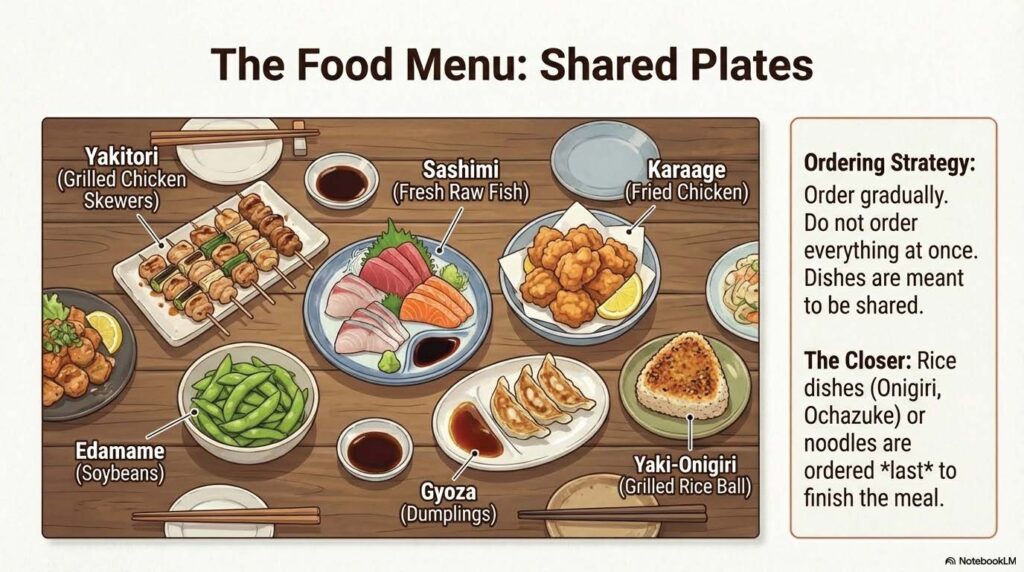
A cold beer (bīru) is the standard opener. Once the drinks are flowing, order a few small plates—sashimi, yakitori, or gyoza—to share. As the evening progresses, you continue to order “a little at a time.” The meal typically reaches its crescendo with the “Last Order” (rasuto ōdā), which is the traditional time to order shime—heavier rice or noodle dishes used to “close” the stomach and soak up the evening’s libations before heading back into the Tokyo night.
Your Seat at the Table Awaits
Whether you are navigating the gleaming, high-quality efficiency of a Shinjuku depachika or dodging the charcoal smoke of a neighborhood izakaya, you are participating in a living history. These spaces offer more than just sustenance; they provide a masterclass in Japanese hospitality, ritual, and the art of the shared moment.
In a city of 160,000 restaurants, will you choose the curated convenience of the modern food hall or the storied ritual of the Izakaya tonight?NotebookLM can be inaccurate; please double check its responses.
Navigating Tokyo Dining: Food Halls vs. Izakayas




Welcome to your culinary orientation. Tokyo is not merely a city; it is a global gastronomic capital where every street corner offers a lesson in flavor and tradition. For the uninitiated, the sheer density of options can be overwhelming, but as your Japanese Culinary Concierge, I am here to help you navigate this landscape with confidence.
To truly understand how this city eats, you must master two essential pillars of the Tokyo food scene: the Food Hall and the Izakaya. Your mission today is to learn how to distinguish between these two environments so you can choose the perfect stage for every moment of your journey.
Whether you are seeking the surgical efficiency of a modern food court or the rhythmic, soulful chaos of a traditional pub, understanding these “personalities” is the key to unlocking the city’s heart.
To begin our curriculum, let us look at the ultimate hub for the modern, busy traveler: the Japanese Food Hall.
The Food Hall: Your Hub for Variety and Convenience
In Tokyo, “Food Halls” are far more sophisticated than the typical western food court. You will encounter them as Depachika (the legendary basement food floors of department stores), within sprawling urban shopping malls, or strategically placed inside major train stations.
- Unrivaled Variety: These halls aggregate diverse cuisines—from artisanal sushi and tempura to high-end Western patisserie—in a single location.
- So What? This “Group Flexibility” is a game-changer; families or groups with conflicting cravings can each select their own perfect meal and still dine together at a communal table.
- Gourmet on a Budget: You can enjoy chef-level quality at a fraction of the cost of a formal sit-down establishment (typically 800–2,000 JPY).
- So What? This allows you to experience premium ingredients and expert preparation without the added expense of a service charge or a formal reservation.
- Seamless Speed: Designed for the fast-paced Tokyo lifestyle, service is lightning-fast.
- So What? You can enjoy a high-quality, authentic meal in under 30 minutes, maximizing your precious time for sightseeing and exploration.
| Type | Primary Vibe | Target Audience |
|---|---|---|
| Department Store (Depachika) | Sophisticated, premium, and vast. | Foodies seeking gourmet variety or high-end gifts. |
| Shopping Mall | Casual, lively, and approachable. | Families and groups looking for comfort and ease. |
| Station-based | Ultra-efficient and fast-paced. | Commuters and travelers needing a quick, tasty fuel-up. |
- Select: Browse the stalls. I recommend looking for the incredibly realistic plastic food samples (shokuhin sampuru) or clear photographic menus to help you decide.
- Order: Pay at the stall’s register. You will typically receive a numbered ticket or an electronic buzzer.
- Wait: Secure a seat in the communal dining area. Keep your buzzer visible so you know when your meal is ready.
- Collect: When alerted, return to the stall to pick up your tray. Enjoy your meal!
While the Food Hall is a masterclass in efficiency, our next subject—the Izakaya—offers a deeper dive into the social fabric of Japanese life.
The Izakaya: An Immersive Cultural Social Club
An Izakaya is a traditional Japanese pub—a vibrant “social hub” where the food is designed to complement the drinks and the conversation. With roots stretching back to the Edo period, these venues have served as the living rooms of the Japanese public for centuries.
- Chain Izakayas: (e.g., Watami, Torikizoku). These are perfect for beginners, offering clear pricing, iPad ordering, and extensive menus that often include English.
- Independent Izakayas: These “one-of-a-kind” spots are where the owner’s personality shines. They offer a more authentic, local experience with specialized “house” dishes.
- Standing Bars (Tachinomi): These counter-only spots are exceptionally affordable and casual. Because of their layout, they are the most accessible and welcoming option for solo travelers looking to rub elbows with locals.
| Japanese Term | English Meaning | When to Use It |
|---|---|---|
| Kanpai! | “Cheers!” | Said loudly before the first sip of the evening. |
| Otoshi | Table Charge | A non-negotiable seat fee (300–500 JPY) that includes a small starter dish. |
| Okawari | “Refill / Another one” | When you want an identical second round of your drink. |
| Okaikei | “The Bill” | When you are finished and ready to settle the tab. |
Note on the Otoshi: Please do not be surprised by this small charge on your bill. It is a traditional cultural “cover charge” that ensures your seat and provides an immediate small bite to enjoy with your first drink.
Top 5 Must-Try Dishes:
- Sashimi: Pristine, expertly sliced raw fish—the ultimate test of a kitchen’s freshness.
- Yakitori: Char-grilled chicken skewers, often seasoned with a savory tare sauce or simple sea salt.
- Karaage: Crispy, juicy Japanese-style fried chicken infused with garlic and ginger.
- Gyoza: Pan-fried dumplings with a delicate “wing” of crispy dough on the bottom.
- Okonomiyaki / Takoyaki: Savory “as-you-like-it” pancakes or octopus-filled dough balls.
- Concierge Tip: Always order your Gohan-mono (rice dishes) at the very end of the meal during the “Last Order” phase—this is the traditional way to finish an Izakaya session.
Top 3 Drinks:
- Beer: The universal “first order” for almost every table.
- Sake (Nihonshu): Brewed rice wine, available cold (reishu) or warmed (atsukan).
- Highball: A refreshing, bubbly mix of Japanese whisky and soda water.
To help you choose the right stage for your evening, let’s look at how these two experiences stack up side-by-side.
Comparative Analysis: Which Venue Suits Your Needs?
| Feature | Food Hall | Izakaya |
|---|---|---|
| Primary Purpose | Efficient, high-quality dining. | Socializing and cultural immersion. |
| Budget (Lunch) | 800 – 1,500 JPY | N/A (Mostly evening-focused). |
| Budget (Dinner) | 1,000 – 2,000 JPY | 3,000 – 5,000 JPY (Standard). |
| Atmosphere | Bright, busy, and functional. | Lively, dimly lit, and nostalgic. |
| Social Interaction | Low; self-service focused. | High; interaction with staff and locals. |
| Best Time of Day | 11:00 AM – 8:00 PM | 7:00 PM – 11:00 PM (Peak hours). |
Choose a Food Hall if…
- You are on a tight schedule or need a quick lunch between sights.
- You are prioritizing your budget without sacrificing food quality.
- Your group has diverse dietary needs (e.g., one person wants ramen, another wants pizza).
Choose an Izakaya if…
- You want to experience Tokyo’s “after-hours” culture like a local.
- You prefer sharing many small plates rather than having one large entrée.
- You are looking for a relaxed, multi-hour social experience.
Regardless of which environment you choose, a few “Golden Rules” will ensure you navigate the experience like a seasoned regular.
Mastering the Experience: Etiquette and Troubleshooting
In Food Halls:
- The Return Station: Always return your tray and dishes to the designated “Return” area.
- Dining Etiquette: Tables are for eating, not for lounging. Please do not occupy seats for long periods after finishing.
- Waste Management: Japan takes recycling seriously; sort your trash into the specific bins for plastics, paper, and glass.
In Izakayas:
- The “Kanpai” Wait: Wait until everyone at your table has their glass filled before shouting “Kanpai!” and taking your first drink.
- The Pouring Ritual: Never pour your own drink from a shared bottle. Pour for your companions, and they will gladly return the favor for you.
- The Shared Plate: Izakayas are communal. Use the provided small plates (torizara) to take portions from the shared dishes.
- Language Hurdles: Use translation apps or look for menus with photos. Most importantly, do not be afraid to point at the plastic food samples in the window—it is a perfectly acceptable way to order!
- Allergy Management: Carry a printed card in Japanese detailing your allergies. This is the most reliable way to communicate dietary restrictions to the kitchen.
- The Non-Drinker’s Path: You are never forced to drink alcohol. Izakayas offer excellent “Soft Drinks” and various types of O-cha (Japanese tea).
This concludes our orientation. You are now equipped with the knowledge to dine with the grace of a local.
Your Culinary Adventure Awaits : Decoding the Japanese Dining Landscape
Whether you find yourself in the polished basement of a Ginza department store or the narrow, atmospheric alleys of a neighborhood Izakaya, remember that neither venue is “better.” They simply serve different purposes in the beautiful tapestry of Tokyo life. The Food Hall provides the convenience and variety required for the modern explorer, while the Izakaya offers a seat at the table of Japanese history and social tradition.
Final Pro-Tip: To see both worlds in a single afternoon, visit Shinjuku, Ginza, or the Ueno/Asakusa area. In Ueno and Asakusa, you can experience the traditional Shitamachi (downtown) Izakaya vibes near the station after exploring the gourmet treasures of a nearby department store. Step out and try both—the city is waiting to feed you!NotebookLM can be inaccurate; please double check its responses.
Tokyo Dining Culture: A Study Guide to Food Halls and Izakayas

This study guide explores the nuances of Tokyo’s vibrant food scene, focusing specifically on the casual efficiency of food halls and the traditional social atmosphere of Izakayas. The following sections provide a comprehensive review of the logistics, etiquette, and cultural significance of these dining establishments.
——————————————————————————–
Instructions: Answer the following questions in two to three sentences based on the provided source context.
- What are the defining characteristics of a Tokyo food hall?
- How do food halls in department stores differ from those in shopping malls?
- What is the step-by-step process for ordering and receiving food in a typical food hall?
- What are the specific etiquette requirements for patrons finishing their meal at a food hall?
- What is an “Izakaya,” and what role has it played in Japanese society historically?
- Distinguish between chain Izakayas and privately owned (individual) Izakayas.
- What is “Otoshi,” and what should a customer expect regarding its cost and service?
- Describe the social etiquette regarding “Kanpai” and pouring drinks for others at an Izakaya.
- When is the peak time for Izakaya service, and how is the billing process typically handled?
- What strategies can international visitors use to navigate language barriers or food allergies?
——————————————————————————–
- What are the defining characteristics of a Tokyo food hall? Tokyo food halls are food courts that congregate multiple restaurants in a single location, often within department stores or shopping malls. They offer a diverse range of cuisines in a casual atmosphere, making them ideal for groups who wish to eat different types of food simultaneously at a relatively low cost.
- How do food halls in department stores differ from those in shopping malls? Department store food halls, typically found in the basement levels of retailers like Mitsukoshi or Isetan, offer high-quality Japanese, Western, Chinese, and ethnic cuisines. In contrast, shopping mall food courts (such as those in Lalaport or Aeon) are geared more toward families and offer more affordable price points.
- What is the step-by-step process for ordering and receiving food in a typical food hall? Patrons begin by selecting a dish from the menus or food samples at individual stalls and then place their order at the register. After receiving a numbered ticket, they must secure a seat and wait for their number to be called before picking up their meal and returning to the table.
- What are the specific etiquette requirements for patrons finishing their meal at a food hall? Upon finishing a meal, guests are expected to return their used dishes and trays to the designated return area rather than leaving them on the table. Additionally, patrons must sort their trash correctly and avoid occupying seats for an extended period to remain considerate of other diners.
- What is an “Izakaya,” and what role has it played in Japanese society historically? An Izakaya is a traditional Japanese pub where people gather to enjoy alcohol and light meals in a casual setting. This culture has persisted since the Edo period, serving as an essential social hub for common people to interact and relax.
- Distinguish between chain Izakayas and privately owned (individual) Izakayas. Chain Izakayas offer standardized menus with clear pricing and frequently provide English menus, making them accessible for newcomers. Privately owned Izakayas offer a more unique atmosphere and specialized dishes created by the owner, providing a more authentic and local experience.
- What is “Otoshi,” and what should a customer expect regarding its cost and service? Otoshi (also known as tsukidashi) is a small, mandatory appetizer served automatically to guests upon being seated. It functions as a cover charge and typically costs between 300 and 500 yen per person.
- Describe the social etiquette regarding “Kanpai” and pouring drinks for others at an Izakaya. It is customary to wait until everyone has their drink and says “Kanpai” (cheers) before taking the first sip. Furthermore, one should never pour their own drink; instead, patrons pour for one another, with the recipient holding their glass as it is being filled.
- When is the peak time for Izakaya service, and how is the billing process typically handled? The peak hours for Izakayas are usually between 19:00 and 23:00, though some stay open until late at night. When paying, “Warikan” (splitting the bill) is the standard practice, and while credit card acceptance is increasing, cash remains very common.
- What strategies can international visitors use to navigate language barriers or food allergies? Visitors can look for establishments with picture menus, use translation apps, or point to items to order. For allergies, it is recommended to carry a card written in Japanese explaining specific dietary restrictions to show to the staff.
——————————————————————————–
Instructions: Use the provided source context to develop comprehensive responses to the following prompts.
- Cultural Contrast: Compare and contrast the social functions of a food hall versus an Izakaya. In what scenarios is one preferred over the other for a Tokyo resident or visitor?
- The Logistics of Izakaya Dining: Detail the chronological flow of a night at an Izakaya, from the initial “Irasshaimase” to the final request for the bill. Include specific mentions of ordering habits and the “last order” concept.
- Economic Overview of Tokyo Dining: Analyze the cost structures provided in the text for both food halls and Izakayas. How do these price points reflect the intended audience (e.g., commuters, families, or social groups)?
- Etiquette and Social Harmony: Discuss the importance of non-verbal and procedural etiquette in Japanese dining, focusing on chopstick use, trash disposal, and the “no-tipping” policy.
- Regional Hubs for Gastronomy: Using the specific districts mentioned (Ginza, Shinjuku, Shibuya, etc.), describe how different areas of Tokyo cater to different dining preferences.
——————————————————————————–
| Term | Definition |
|---|---|
| Irasshaimase | The traditional greeting used by staff to welcome customers upon entering a shop or restaurant. |
| Izakaya | A traditional Japanese pub/tavern serving alcohol and a variety of small dishes. |
| Kanpai | The Japanese equivalent of “Cheers,” used during a toast before drinking. |
| Karaage | Japanese-style fried chicken, a staple menu item in Izakayas. |
| Okaikei onegaishimasu | The formal phrase used to request the bill or check at the end of a meal. |
| Okawari | A request for a second helping or a refill of a drink/food item. |
| Omoide Yokocho | A famous narrow alleyway in Shinjuku known for its dense collection of small Izakayas. |
| Otoshi / Tsukidashi | A small mandatory appetizer served as a cover charge in Izakayas (usually 300-500 yen). |
| Otsukaresama | A common greeting or acknowledgement of hard work, often used when meeting for drinks after work. |
| Sashimi | Fresh, thinly sliced raw fish or meat. |
| Shochu | A Japanese distilled spirit commonly made from sweet potatoes, barley, or rice. |
| Warikan | The practice of splitting the bill equally among a group of people. |
| Yakitori | Grilled chicken skewers, a popular snack often paired with alcohol. |
